6
min read

Matteus Klintell
Osteopath & performance coach
Running with extra weight is one of those training methods that tends to pop-up an immediate question about joints. It is a fair question. The logic seems straightforward: more load on the body means more force through the knees, and more force through the knees means more wear on the cartilage. If running at bodyweight already puts considerable stress on the joints, adding to that must accelerate the damage.
But the physiology works differently to the mechanics. Cartilage is not a fixed material that degrades with use. It is living tissue that responds to the stimulus it receives, and the evidence consistently shows that for recreational runners, adding modest external load falls well within the range that cartilage handles and adapts to positively.
This article covers what the research shows about running, load and long-term joint health, and what it means in practice for runners who want to train with added weight.
The concern about joints and added weight is not irrational. Osteoarthritis affects a significant proportion of the population over time, with the lifetime risk of developing symptomatic knee osteoarthritis estimated at around 45% (Murphy et al., 2008). The idea that high-impact activity accelerates that process, particularly with additional load, is a natural inference from the visible reality of joint wear.
When we talk about joint damage in the context of running, we are talking specifically about articular cartilage: the smooth tissue that lines the ends of bones inside each joint, allowing them to move against each other without friction. It is the degradation of this cartilage that leads to osteoarthritis, and it is this tissue that sits at the centre of the concern about impact and load.
The image most people carry of cartilage is something like a rubber washer, gradually thinning with every impact until the bone surfaces beneath make contact. On that model, more load means faster thinning. The concern follows directly from the assumption.
The issue is that cartilage does not function like a rubber washer. It is a mechanosensitive tissue, meaning it actively senses and responds to the mechanical environment it is placed in. Understanding how that works changes the picture considerably.
Articular cartilage is sensitive to the mechanical stimulus it receives. Regular cyclic loading, the kind generated by running, enhances proteoglycan synthesis within the cartilage matrix and promotes structural adaptation. Research on cartilage mechanoadaptation, reviewed comprehensively by Buckwalter and Martin (2004), consistently shows that appropriate loading maintains and improves cartilage integrity, while disuse and immobilisation lead to reduced proteoglycan synthesis and structural decline. The pattern is not unlike what we see in bone and muscle: load it appropriately and it adapts; remove the stimulus and it atrophies.
The intensity of loading matters. An intensity-dependent effect has been demonstrated across animal models and human studies, with low to moderate intensity loading associated with positive cartilage outcomes and very high intensity loading carrying greater risk. For runners training at easy to moderate intensity, the evidence sits clearly in the beneficial range.
What this means for the established runner is worth considering carefully. Cartilage adapts to the load it regularly receives and, over time, finds an equilibrium at that level. For a runner who has been training consistently at bodyweight for months or years, the cartilage has already adapted to the stimulus of their regular run. At that point, the same route at the same pace generates the same mechanical signal it always has. The adaptive response has plateaued. Adding external weight re-elevates that signal, giving cartilage the kind of progressive stimulus that drives continued adaptation rather than simple maintenance.
Unlike muscle or bone, articular cartilage has no blood supply. It cannot receive nutrients or clear waste through the circulatory system. Instead, it relies entirely on mechanical loading to stay nourished. Compression during a run squeezes metabolic waste out of the cartilage matrix, and the release of that pressure draws nutrient-rich synovial fluid back in. Think of it as a sponge: compress it and it empties, release it and it absorbs. Load the cartilage and it feeds; leave it unloaded and it starves.
This is why the concern about additional loading misses something important. The tissue does not just tolerate load, it depends on it. Slow running with added weight delivers precisely the kind of cyclic compression and decompression that supports cartilage nutrition, while keeping pace low enough to avoid the high-impact shear forces associated with faster running. The cartilage is loaded a little more with each stride, fed a little more in each recovery phase, and given a stronger adaptive signal as a result.
A 2017 systematic review and meta-analysis by Alentorn-Geli et al., published in the Journal of Orthopaedic and Sports Physical Therapy, examined hip and knee osteoarthritis rates across recreational runners, elite runners and sedentary controls. The findings were striking. Only 3.5% of recreational runners in the included studies developed hip or knee arthritis. The equivalent figure for sedentary individuals was 10.2%, and for elite competitive runners it was 13.3%.
Recreational runners, in other words, showed substantially better joint outcomes than people who did not run at all. The elevated rate in elite runners is consistent with the intensity-dependent model: very high training volumes over many years carry different risk profiles to recreational participation. For the runner training regularly at moderate volume, the direction of the evidence is protective, not damaging.
One of the most informative studies on this question is a longitudinal study by Chakravarty et al. (2008) at Stanford University, which followed 45 long-distance runners and 53 healthy non-runners from 1984 to 2002, tracking knee health with serial radiographs across nearly two decades. At the end of the study period, severe osteoarthritis was present in 2.2% of runners compared with 9.4% of controls. The factors most associated with joint deterioration across the full cohort were initial body mass index and pre-existing joint damage at baseline. Running itself showed no significant association with radiographic progression. An 18-year window is long enough to capture the consequences of accumulated joint damage, and the runners came out ahead.
A 2023 systematic review and meta-analysis by Coburn et al., examining 24 MRI studies of knee cartilage before and after running, found that running does transiently decrease cartilage thickness and volume. The changes, however, were small and fully recovered to baseline levels within 91 minutes. Existing cartilage defects showed no progression at 48 hours post-run. The authors concluded that a single bout of running is not detrimental to knee cartilage.
This loading and recovery cycle is the normal physiological process through which cartilage maintains itself. Compression followed by rehydration is how cartilage stays healthy, not a sign of wear.
The evidence as a whole points in a consistent direction: running is not damaging to cartilage at easy to moderate intensity, and may in fact be protective compared to a sedentary lifestyle. But the more specific question for runners interested in weighted training is not whether running is safe. It is whether adding weight to a run provides a meaningful benefit to the tissue beyond what bodyweight running already delivers.
The answer, based on the mechanoadaptation research, is yes. Proteoglycan synthesis, the process that maintains cartilage stiffness and structural integrity, is upregulated in response to load that exceeds the current adapted level. For a runner who has been training consistently at bodyweight, that response has already normalised. Adding 2 to 3% of bodyweight changes the signal. The cartilage receives a mechanical stimulus it has not previously encountered and responds by adapting to it. Running with weight is, in physiological terms, a way to raise the ceiling that bodyweight running has already reached, and to do so without increasing pace, impact rate, or weekly mileage.
The table below summarises the relationship between loading behaviour and joint outcomes across the evidence.
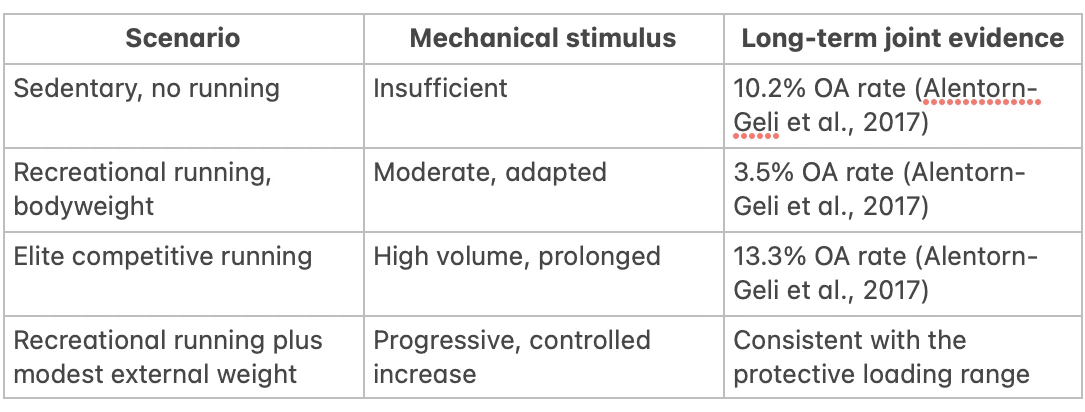
The key principle is progressive introduction. As with any new training stimulus, adding external weight gradually over several weeks allows the joints, tendons and surrounding soft tissue to adapt incrementally rather than absorbing a sudden spike in load.
For runners looking to apply this approach, the Natural Resistance Weighted Hybrid Shorts provide 2kg of integrated load positioned at the hip, allowing the weight to travel with the leg through each stride rather than sitting above the centre of motion. This keeps gait mechanics intact while increasing the total mechanical stimulus per step.
Running with extra weight does not damage healthy joints when load is introduced progressively and the run is kept at easy to moderate intensity. The research shows something more useful than a simple reassurance. Cartilage is adaptive tissue that responds to mechanical stimulus, and for the established runner whose joints have already normalised to bodyweight training, adding modest external load provides a targeted stimulus for continued adaptation. The concern about wearing weight is understandable. The physiology, however, points in the opposite direction.


