4
min read

Matteus Klintell
Osteopath & performance coach
Most runners and fitness enthusiasts trying to lose weight or get fitter make the same fundamental mistake: they try to run FASTER or run LONGER.
The result? Rapidly accumulating lactate, sky-high heart rates, joint wear and tear, and all too often overuse injuries that force you to stop training altogether.
There is a smarter, more sustainable way to trick your body into burning significantly more fat without destroying your joints or altering your running technique. The key lies in adding 5% extra bodyweight placed strategically where your body can handle it.
Here is the deep dive into the physiology of fat loss, biomechanics, and why the 5% sweet spot changes everything.
When it comes to losing fat through cardio, the common approach is to push harder: run faster or add more miles. But both methods carry heavy trade-offs. Running faster spikes your heart rate into the anaerobic zone, where your body burns primarily stored carbohydrates (glycogen) instead of fat. Running longer, on the other hand, demands time you might not have and increases mechanical stress exponentially.
Adding a subtle 5% extra load solves this dilemma through three distinct physiological mechanisms:
Higher Caloric Cost at the Same Heart Rate Zone: Carrying 5% extra weight increases the energy expenditure of every single footstrike. Clinical evaluation of wearable resistance during aerobic sessions demonstrates improvements in cardiovascular capacity (VO2max) of up to 7.2% in recreational runners. Moving a heavier total mass elevates baseline calorie burn while allowing you to remain in your optimal aerobic "fat-burning" zone without crossing your anaerobic threshold.
Fat Loss Without Muscle Loss: Severe calorie deficits or excessive high-intensity cardio often cause the body to catabolize lean muscle tissue alongside fat. Research on wearable resistance shows that carrying extra mass signals the body that muscle tissue is actively needed to support the load, yielding up to 4% more fat loss while preserving lean mass and supporting skeletal muscle adaptation by up to 7.5%.
Resetting the Body’s Internal Weight Sensor: Emerging biological research shows that the body possesses internal mass-sensing mechanisms (often called the gravitostat) that regulate body weight based on the load felt by long bones and joints. By consistently exposing your body to a slight 5% increase in perceived weight during daily movement, you send a signal that the body is carrying excess mass encouraging your metabolism to down-regulate fat storage while keeping muscle intact.
The biggest historical objection to running with weights isn't the weight itself, it's where and how the weight is placed.
Traditional weighted vests stack 10 to 15 kg directly onto your chest and upper shoulders. This alters your center of mass, forces your torso to lean unnaturally forward, compresses the thoracic spine, and drastically increases vertical impact forces on your lower back and knees. An altered stride means inefficient running, higher injury risk, and poor movement habits.
This is where Natural Resistance changes the equation:
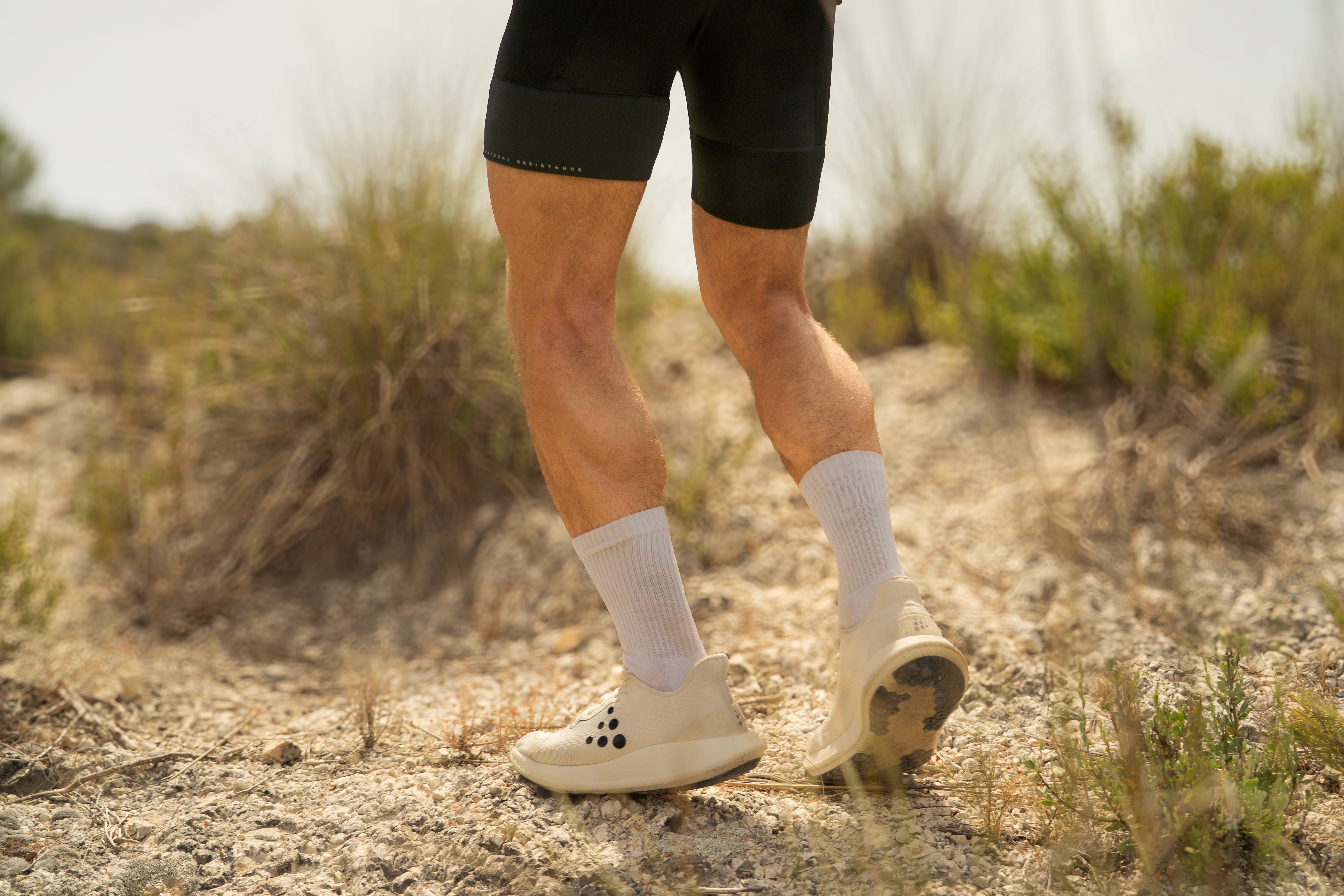
Body-Mapped Weight Distribution: Rather than hanging heavy iron plates over your shoulders, Natural Resistance distributes light weight across targeted lower-body and core zones. Research on lower-limb wearable resistance published in the Journal of Australian Strength and Conditioning demonstrates that strategic thigh loading enhances horizontal force production and power output without disrupting natural gait mechanics. Micro-weights placed close to your center of gravity act as a seamless extension of your own body.
Preserving Natural Gait Mechanics: Because the load is streamlined, soft, and flexible, your biomechanics remain 100% natural. Studies evaluating lower-body wearable resistance confirm that sprint performance and power acceleration improve between 1.2% and 9.4% without compromising natural movement patterns. You get all the metabolic benefits of carrying extra mass while training the exact way you actually run.
Full Range of Motion & Zero Restrictiveness: Unlike rigid vests or bulky ankle weights that bounce and pull on joints, body-contoured wearable resistance allows your limbs to move freely through their full, natural range of motion. You don't have to adjust your posture you simply run normally while your body works 5% harder.
Beyond fat loss, adding a controlled 5% load acts as proactive injury prevention (Prehab).
Cartilage Conditioning: Cartilage has no direct blood supply and relies on cyclic loading (the compression and release of walking or running) to pump in nutrients. Once your joints adapt to your current body weight, adaptation plateaus. Adding 3–5 kg stimulates cartilage cells to become thicker and more resilient, building a protective buffer against long-term degeneration like osteoarthritis.
Tendon Remodeling: Tendons adapt specifically to mechanical stress. A subtle 5% load increases collagen synthesis in the Achilles and patellar tendons, strengthening the tissue so it can absorb higher force without tearing.
Building Skeletal Density: Research across over 20 wearable resistance studies confirms that mechanical loading directly stimulates osteoblasts, increasing bone mineral density by up to 2.8% while decreasing bone resorption.
When fatigue hits near the end of a long run, technique usually degrades. Hips drop, strides shorten, and energy leaks through weak stabilizer muscles.
Because Natural Resistance places load precisely where muscle stabilization happens, it conditions your core, glutes, and stabilizers to hold your posture upright under stress. You are essentially training movement integrity under fatigue. Studies on explosive lower-body loading show performance improvements of up to 8.1% in vertical jump height, proving that lower-limb loading builds raw mechanical power alongside fatigue resistance.
When race day comes and you remove the weight, your body feels lighter, your stride stays crisp, and you maintain peak efficiency long after others begin to slow down.
The Bottom Line
Fast, effective fat loss shouldn't come at the expense of your joints, your energy, or your running technique.
By adding 5% extra bodyweight through Natural Resistance, you unlock higher calorie burn, target fat over muscle, and protect your joints, all while running with the exact same natural form you've always had.
Natural Resistance was built specifically for this: To give you the exact metabolic edge of weighted movement with zero restriction, complete comfort, and perfect biomechanical freedom.
Reference Directory
Sprint Performance & Mechanics (1.2%–9.4% improvement): Macadam P, Nuell S, Cronin JB, et al. Thigh positioned wearable resistance improves 40 m sprint performance: A longitudinal single case design study. Journal of Australian Strength and Conditioning / Taylor & Francis.
Jump Height (+8.1%) & Skeletal Adaptations: Feser EH, et al. Effects of lower-limb wearable resistance on physical performance measures. ScienceDirect / Journal of Electromyography and Kinesiology.
Muscle Retention & Tissue Adaptation (+7.5%): Simperingham K, Cronin J, et al. Acute changes in running performance and muscle loading following ballistic exercise with lower body loading. PMC / NIH National Library of Medicine.
Metabolic & Bone Density Synthesis (+7.2% VO2 max, +4% Fat Loss, +2.8% Bone Density): Grobler L, Feser E, et al. Changes in cardiovascular, bone density, and metabolic measures during moderate-intensity aerobic exercise with wearable resistance (Synthesis of 20+ clinical studies 1985–2021). [Omorpho / Journal of Sports Science].